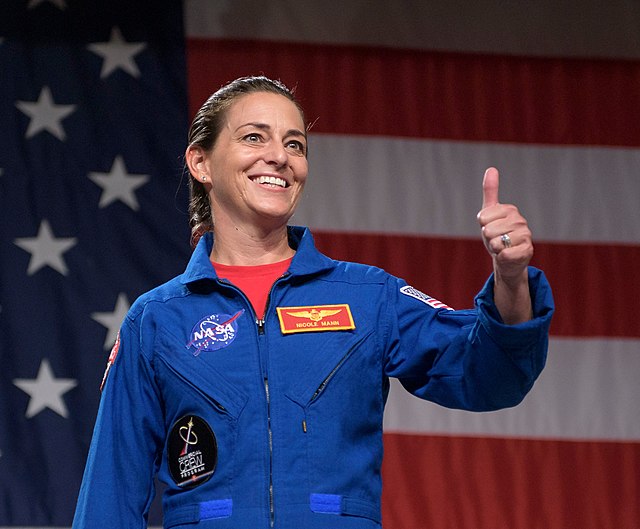
Nicole Mann Becomes the First Native American Woman in Space

NASA astronaut, Nicole Aunapu Mann, has just become the first Native American woman to go to space following the successful launch of the SpaceX Crew Dragon Endurance rocket on Wednesday.

Mann, 45, who is a member of the Wailacki Tribe of the Round Valley Indian Tribes of Covelo, California, will be mission commander on the NASA and SpaceX Crew-5 mission, which is heading to the International Space Station for six months. The crew of four successfully launched from the Kennedy Space Center on the 5th of October after a two-day delay due to Hurricane Ian.

This mission marks a historic moment for the nation’s Indigenous community, as Nicole Mann becomes the first Native American woman to leave the Earth. It has been 20 years since the first Native American man achieved the same milestone, when John Herrington (Chickasaw) took part in a space mission in 2002.

Mann studied mechanical engineering at the US Naval Academy and Stanford University before going on to work as a test pilot, having qualified as a Colonel in the US Marine Corps. In addition to leading the SpaceX Crew-5 mission, she will be involved in preparations for the upcoming Artemis mission, making her a potential candidate to go to the moon within the next five years.

Mann’s passion and drive not only make her an inspiration for other Indigenous women and girls, but a role model for the younger generation as a whole. She hopes that her extraordinary personal achievements will demonstrate that it is possible to overcome societal barriers and follow your dreams, irrespective of race, gender or religion: “My message to the Native youth out there is that there is no end to the possibilities. Whatever you’re passionate about, go for it and pursue that dream. It won’t always be easy, but it’s definitely worth it.”

The Amazon Guardians have come to Europe

The Onaway Trust is proud to be supporting the Amazon Guardians in their tireless fight to defend Brazil’s Indigenous peoples, their territory and the future of the planet we all rely on.

© Katie Mähler/ Survival International

Olimpio Guajajara, an Amazon Guardian from the Indigenous Guajajara tribe of Araribóia territory in Brazil, has recently visited Europe for the first time on a mission to raise awareness of the suffering and threats facing his people at the hands of money-grabbing industries.

The Amazon Guardians are a brave and dedicated group of Guajajara tribal members willing to risk their lives in order to stand up for the rights and lands of Indigenous Amazonian peoples, including the uncontacted Awá tribe, who are under constant threat from invasion by illegal loggers and cattle ranchers hoping to exploit their native lands for profit.

After visiting London to deliver speeches and make several media appearances,  Guardian leader, Olimpio, travelled throughout the continent in an effort to raise support for the group’s work and cause. The Onaway Trust had the great honour of speaking with Olimpio during his UK visit and we are proud to be working once again with long-term partner organisation Survival International in order to support the Amazon Guardians in their crucial mission.

Fighting back against these powerful and government-backed forces is highly dangerous work, with 80 Guajajara members having been killed in the last two decades alone. On the 3rd of September, Olimpio and his tribe received the shocking news that a sixth member of the Amazon Guardians, Janildo Oliveira, had been murdered for defending this precious territory, an area which is supposed to be protected by law. None of the murderers have yet been brought to justice. This tragedy further highlights the need for international support and solidarity with the Guardians’ cause and will surely add further fuel to the fire as they continue their vital and inspiring work.

Onaway believes that all Indigenous peoples deserve the right to live their traditional lifestyles free of exploitation and oppression. If you’d like to join us in our support of the Amazon Guardians or wish to find out more about their fight against genocide and environmental destruction, please follow the links throughout.

Indigenous issues highlighted by winners of global photo contest

“The awarded work invites us to step outside the news cycle and reflect on the devastating effects of colonisation and the importance of preserving indigenous knowledge.” – World Press Photo Foundation

© Amber Bracken for The New York Times

Various photographic series representing the perspectives and plight of indigenous peoples and the environment have been awarded the title of global winners of the 2022 World Press Photo Contest. 

The overall winner of the World Press Photo of the Year title has been very deservedly granted to photographer Amber Bracken for her striking and evocative image depicting red dresses hung on a row of crosses, captured at the site of the former Kamloops Residential School in Canada, to commemorate the thousands of children who tragically lost their lives in the residential school system.

After the recent discovery of up to 215 unmarked graves at this site, Amber decided to use her photography skills to honour and commemorate the children, highlighting their suffering and the unthinkable injustices they faced at these institutions.

Residential or factory schools were first established in Canada in the late 19th century with the aim of removing indigenous children from their families and communities in order to indoctrinate them to conform to the dominant Western way of life, while forcefully and often violently eradicating their native cultures and languages.

Although these horrific institutions are no longer in operation in Canada and the US, similar factory schools still exist today around the world in countries such as India and Malaysia. An estimated 2 million indigenous children are still being subjected to these abusive and racist practices, which are designed to create an obedient future workforce but are leading to thousands losing not only their cultures, but also their lives as a result.

The competition’s other three global winners consist of similarly striking images highlighting indigenous and environmental issues, from the plight of tribes in the Amazon rainforest as a result of the deforestation, logging and mining taking place at the merciless hands of Jair Bolsonaro, to the loss of ancestral knowledge and heritage in Ecuador following colonisation and forced migration, and the vital role of the indigenous Nawarddeken people of Australia in preventing wildfires and protecting the environment.

The recognition of these projects and the voice they give to global indigenous perspectives at such a crucial time in history is something to be celebrated. In the words of the global jury chair, Rena Effendi, “All four of them, in their own unique ways, address the consequences of humanity’s rush for progress, and its devastating effects on our planet.”

Find out more about the World Press Photo Contest and the stories behind this year’s winning submissions and their creators.

Lakota Waldorf School: Education for the head, heart and hands

Situated on the Pine Ridge Indian Reservation in South Dakota, the Lakota Waldorf School merges traditional education with the Waldorf pedagogy and teaching of the native Lakota language, culture and values, to give local children the best start in life while nurturing a deep connection with their ancestral land and roots.

As the only Waldorf school situated on an Indian Reservation in the US, the school gives Lakota children the chance to benefit from an educational movement which integrates seamlessly with the values and teachings of their own native culture. This is a unique opportunity which most Native American families cannot afford due to high rates of unemployment and poverty among their communities.

The Onaway Trust is a long-term supporter of this visionary school and has recently made a further donation to help fund their inspiring work and further expansion.

Read the full article to find out more about this partnership and the amazing work that the Lakota Waldorf School is doing to guide the next generation of Native American children to succeed academically and in the wider world, while nurturing their connection with Mother Earth, supporting their development as creative, spiritual and compassionate individuals and, crucially, showing them how to embrace and celebrate their native roots.

The Kogi: An ancient civilisation with an urgent message for the modern world

The Kogi are some of the last few surviving descendants of the Tairona, an ancient civilisation dating back to the pre-Columbian era, who escaped colonial persecution by retreating to the remote mountains of northern Colombia. Having kept themselves isolated and uncontactable for centuries, the Kogi have finally decided to speak to the outside world in order to pass on an urgent message and help us to repair our connection with Mother Earth before it is too late.

Read our new article about the Kogi people, their vital message, and how the Onaway Trust supports them through its long-term partnership with the Tairona Heritage Trust.

en_GBEN_GB